English
 Français
 Tiếng Việt


Building or repairing an aquarium requires a sealant that can hold glass panels together under constant water pressure while remaining chemically inert for fish, plants, and invertebrates. Ordinary silicone may bond adequately, but it often contains additives that leach into the water over time. Grade 347 aquarium silicone sealant from XMC Sealant is formulated to solve both problems at once: it delivers high tensile strength through a pure acetoxy-cure silicone network, and it leaves no toxic residue once fully cured. This article explains how one product achieves both structural performance and biological safety.
If you are comparing sealants for a tank project, a useful starting point is understanding what makes a silicone sealant truly safe for aquarium use. Grade 347 is designed around exactly those criteria.
Grade 347 is built around a one-component, acetoxy-cure silicone system. When the sealant is exposed to moisture in the air, it releases acetic acid as a curing by-product while cross-linking into a solid elastomer. This by-product matters for two reasons. First, it creates a tough, high-modulus rubber that grips glass tightly. Second, acetic acid is volatile and evaporates during the cure cycle, leaving behind an inert silicone material.
Many general-purpose sealants contain fungicides, plasticizers, or solvents. These additives can leach out slowly when the sealant is submerged. Grade 347 uses a 100% silicone base and deliberately avoids these substances, so after full curing the rubber is chemically stable and safe for aquarium inhabitants. The absence of additives also helps the polymer network stay dense, which directly supports higher tensile strength.
During curing, moisture causes the silanol end groups in the silicone polymer to condense into long, cross-linked chains. The more cross-links that form per unit volume, the more energy the material can absorb before tearing. Acetoxy catalysts promote efficient cross-link formation, which is why Grade 347 can achieve high tensile strength without relying on reinforcing fillers or toxic additives.
XMC Sealant offers Grade 347 as a dedicated aquarium-grade silicone sealant for glass tank assembly and repair.
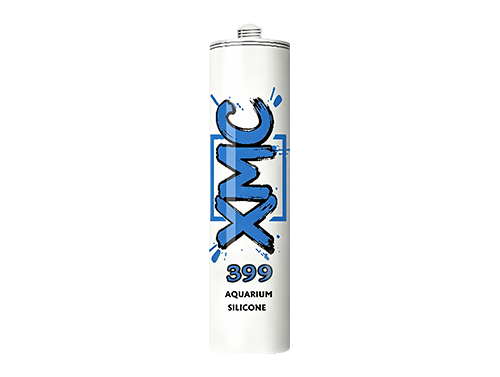
 XMC399 Aquarium-Safe Silicone Sealant for Glass TanksThis high-modulus silicone forms a rigid bond that resists excessive stretching, helping keep glass seams aligned under hydrostatic pressure. Its non-toxic, solvent-free formula is safe for aquatic life after full cure.View Product →
Tensile strength measures how much stress a cured sealant can withstand before breaking, but modulus matters just as much for an aquarium. High modulus means the cured rubber is stiff and does not stretch excessively under load. For glass panels, this translates into a rigid bond that keeps seams aligned under the hydrostatic pressure created by a full tank.
Acetoxy silicones bond well to clean glass because the curing chemistry promotes strong interaction with polar glass surfaces. Grade 347 forms a reliable interface with glass, and its high modulus transfers stress across the joint rather than allowing the sealant to deform and detach over time. This is especially important for large aquariums where the weight of water creates continuous force on every seam.
Aquarium environments often fluctuate between warmer conditions during the day and cooler conditions at night, especially in planted tanks with lighting systems. Grade 347 maintains its tensile strength across these cycles because the silicone backbone is inherently flexible, while the cured material resists hydrolysis. In practical terms, water does not break down the polymer structure after the sealant has fully cured.
Safety claims around silicone sealants often cause confusion. All acetoxy silicones release acetic acid during curing, which creates a vinegar-like smell. That smell is normal and does not indicate toxicity. The real concern begins after the sealant has cured: does the material release anything into the water over weeks and months?
Acetic acid is a by-product of the cross-linking reaction, not an ingredient that remains trapped in the rubber. Once curing is complete, the silicone network is fully formed and the acetic acid has evaporated. Toxic leaching, by contrast, comes from additives that stay inside the polymer and slowly migrate outward, including solvents, plasticizers, and biocides. Grade 347 avoids these ingredients at the formulation stage, so there is no reservoir of leachable compounds.
A safe aquarium sealant is not the one with the shortest ingredient list; it is the one whose cured polymer is fully inert and structurally reliable under water.
A truly aquarium-safe sealant must be chemically stable after curing, resistant to water absorption, and free of antimicrobial additives that could harm invertebrates or sensitive fish. Grade 347 is specifically designed for aquarium construction, combining a high-strength structural elastomer with a non-toxic cured profile. This dual focus is what separates a dedicated aquarium silicone from a general-purpose tube that merely happens to be silicone.
The following summary compares the characteristics that matter most when choosing a sealant for an aquarium build or repair.
| Property | Grade 347 Performance | Why It Matters |
|---|---|---|
| Base polymer | 100% silicone with acetoxy cure | Strong adhesion to glass and long service life |
| Tensile strength | High-strength elastomer | Resists hydrostatic pressure and joint movement |
| Curing by-product | Acetic acid released during cure | Evaporates completely, leaving no toxic residue |
| Modulus | High modulus | Keeps glass seams rigid and stable |
| Additives | None that leach after cure | Safe for fish, shrimp, and aquatic plants |
| Typical cure time | Skin in 24-48 hours; full cure up to 7 days | Allows proper water testing before adding livestock |
Even a high-tensile sealant will fail if the surface is not prepared correctly. The strength of the final bond depends on clean, dry glass and an even application bead.
The smell is acetic acid being released during the curing process. It is a normal part of silicone cross-linking. Do not expose fish to the smell: wait until it disappears completely and the sealant reaches full cure. Once fully cured, Grade 347 no longer releases acetic acid.
No. Even though the cured product is aquarium-safe, Grade 347 requires a clean, dry surface and several days of cure time. The tank should be emptied, dried, and ventilated before application, then water-tested after the sealant has fully cured.
The surface should no longer feel tacky, and the vinegar smell should be gone. As a stricter test, wait at least seven days at room temperature with good ventilation before filling the tank. This gives the silicone network enough time to reach its full tensile strength.
Grade 347 solves the fundamental dilemma of aquarium sealing: it gives aquarists a high-strength adhesive with the confidence that no toxic by-product will leach into the water after curing. Because its performance comes from silicone chemistry rather than chemical additives, the sealant offers both structural reliability and biological safety. Whether you are building a new tank or repairing an old seam, Grade 347 is formulated for the job. To learn more about the manufacturing and quality control approach behind XMC Sealant products, visit the company profile page.