English
 Français
 Tiếng Việt


Content
Anyone who has renovated or retrofitted a building knows the picture: the window and door frames are installed, but a ring of gap remains between frame and wall. Air-conditioning pipes, water lines and conduits pass through the wall and leave dark openings behind. Wall panels and precast slabs meet with long, narrow joints. These gaps look minor, yet they leak air, transmit noise, admit dust, and tend to collect condensation and damp in cold weather.
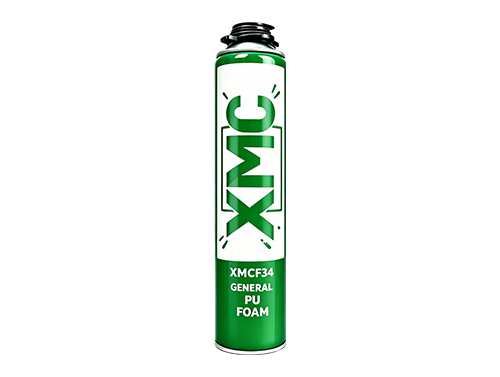
XMC F34 General Purpose PU Foam is designed for exactly these filling, sealing and insulation needs. It is a one-component polyurethane foam that expands after application and cures into a lightweight foam structure, providing gap filling, adhesion and thermal insulation.
F34 uses a one-component formulation. The canister is ready to use as soon as it is opened, with no on-site weighing, stirring or ratio control.
For installation crews and maintenance teams, that means less preparation time, a lower risk of mixing errors, and easier access for scattered tasks such as finishing around door and window frames, sealing pipe penetrations, or installing cabinets. According to the TDS, the product is suitable for professional construction and building maintenance applications.
Some gaps are straight. Others are angled, deep, irregular in shape, and uneven in width. Conventional filling materials often cannot seal them in one pass and require repeated touch-ups.
F34 offers a high expansion ratio: approximately 35–45 times for the gun type and approximately 30–45 times for the straw type. The foam keeps expanding inside the gap after application, filling larger and irregular cavities in one operation and reducing the need for second-pass topping up.
Filling the gap is only the first step. What shapes the actual experience in a building is whether the filled joint blocks air movement, reduces noise and resists moisture.
The cured foam structure of F34 reduces heat transfer and provides thermal insulation. It also reduces airborne noise, which contributes to sound control around doors and windows. After curing, the product offers good water resistance and moisture resistance, making it suitable for areas exposed to damp or requiring water protection.
If foam merely sits inside a gap, it can work loose over time and the opening reappears. F34 provides good adhesion to a range of substrates, bonding to common building materials such as concrete, bricks, wood, metal and PVC, so the filling layer stays firmly attached to the substrate.
Combined with its sealing performance, it effectively fills gaps, holes and irregular spaces, forming a continuous filling layer rather than a surface-level cover.
F34 is a moisture-curing product that cures using moisture from the air. Tack-free time is approximately 5–10 minutes, full curing takes approximately 24 hours, the optimal application temperature is 18–25°C, and the recommended ambient application range is 5–35°C. Full performance data is listed in the typical physical properties table below.
F34 is available in gun type and straw type, differing mainly in density and expansion ratio: gun type at approximately 25–30 kg/m³ with an expansion ratio of approximately 35–45 times, and straw type at approximately 30–35 kg/m³ with an expansion ratio of approximately 30–45 times. The choice depends on the application method, gap size and required volume.
The product is supplied in 300 ml, 500 ml and 750 ml canisters.
| Item | Gun Type | Straw Type | Execution standard |
|---|---|---|---|
| Density (kg/m³) | 25–30 | 30–35 | FEICA TM1019:2014 |
| Foam expansion ratio (times) | 35–45 | 30–45 | FEICA TM1003:2013 |
| Item | Typical Value | Execution standard |
|---|---|---|
| Tensile strength, aluminium panel (kPa) | 80–110 | — |
| Shear strength, aluminium panel (kPa) | 80–1800 | ISO 844:2021 |
| Minimum canister temperature before use (°C) | >5 | — |
| Operating ambient temperature (°C) | 5–35 | — |
| Tack free time (min) | 5–10 | — |
| Fully curing time (hour) | 24 | — |
| Optimal application temperature (°C) | 18–25 | — |
| Post-curing temperature resistance, cured (°C) | -40 to +100 | — |
| Minimum relative humidity | ≥45% | — |
| Shelf life (month) | 12 | — |
| Curing system | Moisture curing | — |
| Foam colour | Beige | — |
| Clipping time (min) | 20–45 | — |
The values above are typical figures obtained under the conditions specified in the TDS. Actual results may vary with materials, application method and site conditions.
Per the TDS method of application, dust, greasy dirt and standing water should first be removed from the bonding surface with cotton yarn. If the surface carries rust that peels away easily, it should be removed with a metal brush first; where necessary, the surface may be wiped with an organic solvent such as acetone.
The nozzle is cut to the required size and screwed onto the canister, then applied with a manual or compressed-air gun. The surface should be tooled immediately after application. Where appearance matters, masking tape can be applied along both sides first and removed after tooling to achieve a cleaner finish.
Keep the packaging sealed during transport, away from moisture, direct sunlight, high temperature and impact. Store in a dry place below 25°C, avoiding high temperature and humidity. Shelf life is 12 months; first-in, first-out stock rotation is recommended.
Shanghai XMC New Material Technology Co., Ltd. was founded in 2004 and specializes in the research, development and manufacturing of sealants and adhesive products for construction and industrial applications. With more than two decades of industry experience, XMC has built a modern production system integrating product development, manufacturing and international trade, with a plant area of approximately 80,000 m², annual output of approximately 60,000 t, and more than 500 containers shipped per year.
XMC's product portfolio covers silicone sealants, hybrid sealants, MS sealants, liquid nails, polyurethane foam, automotive sealants and various industrial bonding materials. The company serves global distributors, building material suppliers and project customers with stable products and customized services, backed by 20 years of OEM/ODM experience and more than 1,000 custom colours.
For more information about XMC products and cooperation opportunities, please visit:
https://www.xmcsil.com