English
 Français
 Tiếng Việt


Content
In external wall insulation, roofing and interior fit-out projects, fixing insulation boards, XPS panels and rock wool boards firmly to the substrate is often the step where things go wrong.
Traditional liquid adhesives are difficult to spread evenly on uneven walls or roofs, and boards tend to slide once placed. Some substrates absorb moisture quickly, drawing it out of the adhesive before it can cure. And when the adhesive does cure, expansion or shrinkage may push the boards up and create bulges. When schedules are tight, waiting time and rework have a direct impact on cost.
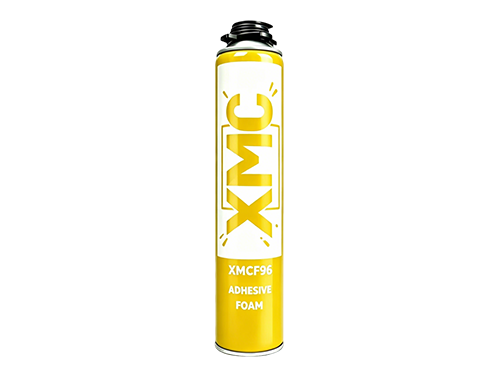
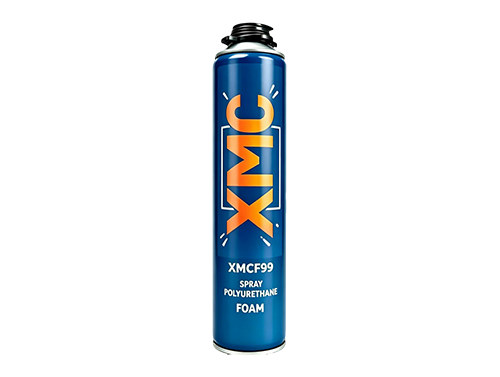
XMC® F96 was developed specifically for holding boards in place. It is a one-component, fast-curing polyurethane foam adhesive with a clearly defined job: bonding insulation materials and boards firmly to walls and roofs. The formulation is purpose-built for bonding and insulation work.
F96 is widely used in construction, insulation and landscaping projects, particularly in situations where traditional liquid adhesives struggle — uneven substrates, materials subject to movement, and complex or irregular surfaces.
PU foam combines insulation, sealing and bonding in one material, which is why it is often referred to as PU adhesive. In practice, the most typical application of F96 is fixing insulation boards in thermal insulation composite systems (TICS / ETICS).
Two things matter most when bonding insulation boards: the bond has to hold, and the boards must not be pushed apart.
F96 is strengthened for adhesion: tensile strength (aluminium panel) is 90–140 kPa and shear strength (aluminium panel) is 140–220 kPa, which together with its excellent bonding properties delivers a firm joint across a range of construction materials.
Expansion is also controlled. The foam expansion ratio is approximately 40–45 times for the gun type and approximately 35–40 times for the straw type — enough to fill, but not excessive — making the product suitable for areas requiring minimum foam expansion. According to the TDS, it forms a fine film layer on the application area and does not cause swelling after curing, so boards are not lifted and the surface stays level.
F96 is a fast-curing product that is quick and easy to apply. The TDS notes that it provides substantial savings on workmanship and time cost.
Tack-free time is approximately 5–10 minutes, with full curing in approximately 24 hours. For external wall insulation work that involves continuous board installation and a fast move to the next stage, this pace shortens process waiting time and reduces rework caused by board slippage.
The product is one-component and applied with a gun-type or straw-type applicator, with no on-site weighing or mixing required, which lowers the skill threshold and reduces the risk of ratio errors.
Insulation installation often spans different seasons with large temperature swings. F96 allows considerable margin:
Two points are worth noting for installation teams. F96 is a moisture-curing product, so curing is affected when relative humidity falls below 45%. Canister temperature and ambient temperature directly affect dispensing behaviour and foaming performance, and in low-temperature conditions the canister should be conditioned in line with the TDS requirements.
| Item | Gun Type | Straw Type | Execution standard |
|---|---|---|---|
| Density (kg/m³) | 25~30 | 35~40 | FEICA TM1019:2014 |
| Foam expansion ratio (times) | 40~45 | 35~40 | FEICA TM1003:2013 |
| Item | Typical Value | Execution standard |
|---|---|---|
| Tensile strength, aluminium panel (kPa) | 90–140 | — |
| Shear strength, aluminium panel (kPa) | 140–220 | ISO 844:2021 |
| Minimum canister temperature before use (°C) | >0 | — |
| Operating ambient temperature (°C) | -5~35 | — |
| Tack free time (min) | 5~10 | — |
| Fully curing time (hour) | 24 | — |
| Optimal application temperature (°C) | 18~25 | — |
| Post-curing temperature resistance, cured (°C) | -40 to +100 | — |
| Minimum relative humidity | ≥45% | — |
| Shelf life (month) | 15 | — |
| Curing system | Moisture curing | — |
| Foam colour | Light gray | — |
| Clipping time (min) | 20~45 | — |
The values above are typical figures obtained under the conditions specified in the TDS. Actual results may vary with materials, application method and site conditions.
Substrate preparation remains the precondition for a reliable bond. The surface should be clean and dry, free from dust, grease and standing water. If rust that peels away easily is present, remove it first with a metal brush and, where necessary, wipe the surface with an organic solvent such as acetone.
Fit the canister with a gun-type or straw-type applicator and apply with a manual or compressed-air gun. Press the board into position promptly after application so the adhesive layer makes full contact with both substrate and board. Where appearance and joint control matter, masking tape can be used to position the board and removed after tooling for a clean finish.
Note that adhesive layer thickness, board weight, substrate flatness and ambient temperature and humidity all influence open time and final bond strength. A small trial area is recommended before large-scale application to confirm consumption and pressing time.
The product is supplied in 300 ml, 500 ml and 750 ml canisters, suitable for small repairs, regular installation and large projects.
Keep the packaging sealed during transport, away from moisture, direct sunlight, high temperature and impact. Store in a dry place below 25°C, avoiding high temperature and humidity. Shelf life is 15 months; first-in, first-out stock rotation is recommended.
Shanghai XMC New Material Technology Co., Ltd. was founded in 2004 and specializes in the research, development and manufacturing of sealants and adhesive products for construction and industrial applications. With more than two decades of industry experience, XMC has built a modern production system integrating product development, manufacturing and international trade, with a plant area of approximately 80,000 m², annual output of approximately 60,000 t, and more than 500 containers shipped per year.
XMC's product portfolio covers silicone sealants, hybrid sealants, MS sealants, liquid nails, polyurethane foam, automotive sealants and various industrial bonding materials. The company serves global distributors, building material suppliers and project customers with stable products and customized services, backed by 20 years of OEM/ODM experience and more than 1,000 custom colours.
For more information about XMC products and cooperation opportunities, please visit:
https://www.xmcsil.com