English
 Français
 Tiếng Việt


Content
A modern mirror is not simply a sheet of glass. The reflective surface depends on a thin metallic layer, usually silver or aluminum, that sits directly behind the glass and is covered by one or more protective paint layers. This backing is what produces the reflection, and it is also the single most fragile part of the entire product. Once air, moisture, or reactive chemicals reach that metallic layer, oxidation begins almost immediately, and the damage cannot be reversed.
Edge staining, black spotting, and cloudy patches around the perimeter of a mirror are almost always signs of backing corrosion caused by an incompatible sealant or adhesive. In humid bathrooms, coastal climates, or commercial washrooms with frequent cleaning cycles, this deterioration can appear within months rather than years if the wrong bonding material was used during installation.
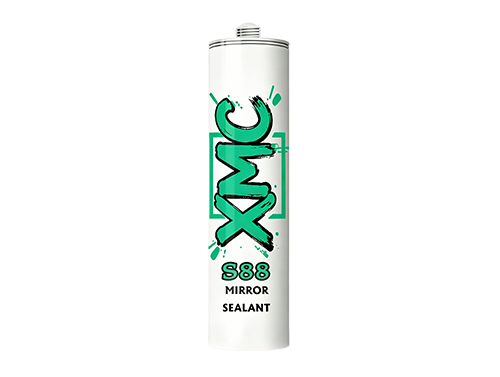
Silicone sealants harden through a chemical reaction that releases a byproduct as the material cures. That byproduct is the deciding factor in whether a sealant is mirror safe. Acetoxy, or acid cure, silicone releases acetic acid vapor during curing. This vapor is mildly corrosive, and in an open joint it dissipates harmlessly. Against a mirror back coating in a confined, low airflow gap, the same vapor becomes concentrated and attacks the metallic layer directly.
Neutral cure silicone uses an alternative cross linking chemistry that releases alcohol based or oxime based byproducts instead, both of which are far less reactive toward metal coatings. This is why every reputable mirror manufacturer and glazing standard specifies neutral cure as the only acceptable chemistry for direct contact bonding.
| Property | Acid Cure Silicone | Neutral Cure Silicone |
|---|---|---|
| Curing byproduct | Acetic acid vapor | Alcohol or oxime based vapor |
| Odor during cure | Strong vinegar smell | Mild or near odorless |
| Mirror backing safety | Not safe for direct contact | Safe for direct contact |
| Typical cure speed | Fast surface skin | Slightly slower skin, full depth similar |
| Common use cases | General glazing, non-metallic substrates | Mirrors, metals, sensitive coated surfaces |
A simple field indicator many installers rely on is smell. A sharp, vinegar-like odor while the bead is still wet almost always signals acid cure chemistry, which should never be used where the sealant touches a mirror back coating.
A properly formulated neutral cure product does more than simply avoid releasing acid. Mirror grade formulations are engineered with a lower migration profile, meaning the plasticizers and additives inside the sealant are far less likely to leach out over time and interact with the paint layers on the mirror back. This matters because even a chemically neutral sealant can still cause staining months later if its internal additives are unstable.
Together these mechanisms explain why a correctly selected mirror adhesive can maintain a clean, corrosion free edge for the full service life of an installation, while a mismatched general purpose sealant can visibly degrade the same mirror within a single humid season.
Not every product labeled neutral cure is automatically appropriate for mirror work. Selection should be based on documented compatibility rather than assumption. The following factors form a practical checklist for specifiers and installers.
| Criterion | Why It Matters |
|---|---|
| Manufacturer mirror compatibility statement | Confirms the product has been tested directly against silvered or aluminized backing |
| Neutral cure chemistry classification | Eliminates acid vapor exposure at the bond line |
| Low migration additive package | Reduces long term staining risk from plasticizer leaching |
| Movement capability | Accommodates thermal expansion without cracking the seal |
| Cured hardness range | Should stay flexible enough to absorb minor substrate movement |
Installation technique matters as much as material choice. Even a fully mirror safe sealant can fail prematurely if applied incorrectly. The sequence below reflects standard practice used in commercial glazing and residential bathroom fit outs.
Leaving ventilation channels behind the mirror is a detail that is often overlooked. Full sheet bonding traps any residual moisture or vapor against the back coating, which can encourage corrosion even when a neutral cure product has been used correctly.
Field reports from glazing and renovation projects point to a small set of recurring errors. Recognizing these in advance avoids most warranty claims and callback visits.
| Mistake | Resulting Problem |
|---|---|
| Using a general purpose acid cure sealant | Edge blackening within weeks to months |
| Full sheet adhesive bonding with no air gap | Trapped moisture accelerates coating breakdown |
| Sealing directly over old, uncured acid cure residue | Continued vapor release under the new bead |
| Skipping the manufacturer compatibility check | Unverified additive migration risk |
| Installing in high humidity without adequate cure time | Incomplete cross linking and reduced bond strength |
Before committing to a full installation, apply a small test bead to an offcut of the same mirror stock, leave it in place for several days, and inspect the contact area for any discoloration. This simple step catches most compatibility problems before they reach a finished wall.
Post installation inspection data collected from commercial bathroom refits over multi year periods consistently shows the same pattern. Sites where a documented neutral cure, mirror rated sealant was specified report edge corrosion incidence in the low single digit percentage range after several years of service. Sites where a general construction sealant was substituted, often to save cost or due to unavailability, report corrosion related complaints in a substantially higher proportion of units, frequently within the first eighteen months.
Climate is a compounding factor rather than a root cause. Coastal and high humidity regions accelerate the timeline of failure when the wrong sealant is used, but they do not create failure on their own. Correctly specified neutral cure products have performed reliably across humid coastal sites, dry inland sites, and temperature controlled commercial interiors alike, which reinforces that material chemistry, not climate, is the dominant variable.
Specification discipline at the procurement stage prevents the overwhelming majority of mirror backing failures. Verifying cure chemistry and mirror compatibility documentation before an order is placed is a far more reliable safeguard than attempting field remediation after staining has already started, since backing corrosion cannot be reversed once it begins.
No. Only neutral cure silicone formulated and tested for mirror compatibility should contact the back coating. Acid cure and many general purpose sealants release byproducts that corrode the metallic backing over time.
Check the technical data sheet or product label for a neutral cure or oxime cure classification, and confirm the manufacturer explicitly states mirror or metal compatibility. A strong vinegar odor during application is a warning sign of acid cure chemistry.
Yes. Applying sealant in vertical beads instead of a full sheet allows residual moisture and vapor to escape rather than becoming trapped against the back coating, which reduces the risk of corrosion even with a compatible sealant.
Full depth cure typically takes several days depending on bead thickness, ambient humidity, and temperature. The manufacturer technical data sheet should always be consulted for exact timing before the installation is considered complete.
Backing corrosion is primarily a cosmetic and reflective quality issue rather than an immediate structural one, but severe adhesive failure at the bond line can compromise how securely the mirror is held in place, which is a separate safety concern.
Once the metallic backing has oxidized, the discoloration is permanent and cannot be restored. Prevention through correct sealant selection and installation technique is the only reliable approach.