English
 Français
 Tiếng Việt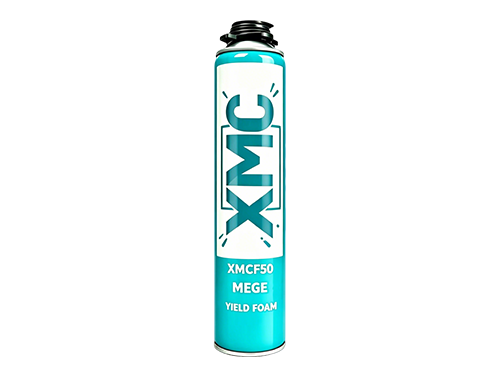


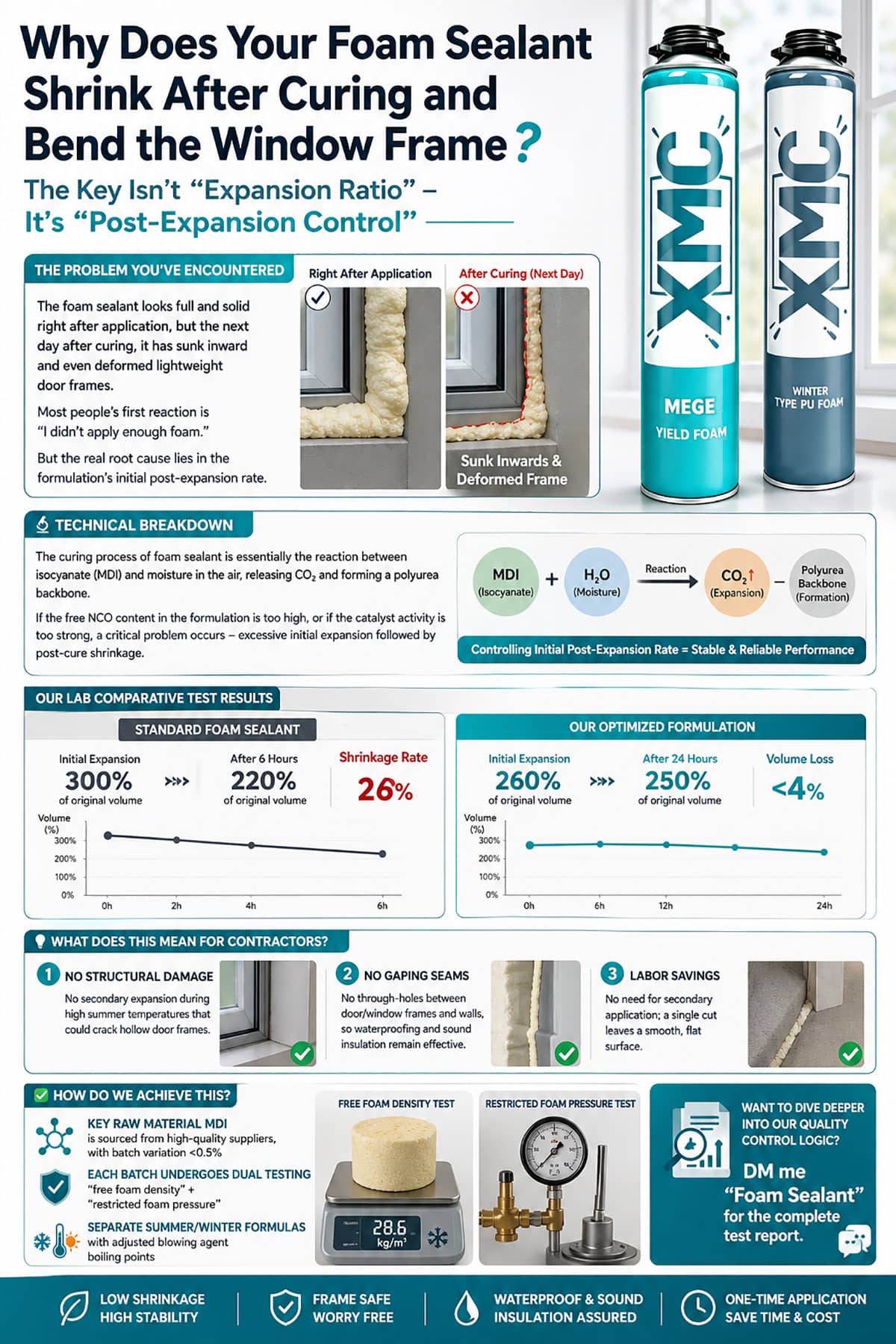
Many purchasers and installers have encountered this strange phenomenon: The foam sealant looks full and solid right after application, but the next day after curing, it has sunk inward and even deformed lightweight door frames. Most people's first reaction is "I didn't apply enough foam." But the real root cause lies in the formulation's initial post-expansion rate.
Technical Breakdown:
The curing process of foam sealant is essentially the reaction between isocyanate (MDI) and moisture in the air, releasing CO₂ and forming a polyurea backbone. If the free NCO content in the formulation is too high, or if the catalyst activity is too strong, a critical problem occurs – excessive initial expansion followed by post-cure shrinkage.
Our lab conducted comparative tests (see data in the attached image):
· Standard foam sealant: Initial expansion to 300% of original volume, dropping to 220% after 6 hours – a shrinkage rate as high as 26%
· Our optimized formulation: Strictly control the NCO index to XX±1, using a gradient catalysis system. Initial expansion is controlled at 260%, stabilizing at 250% after 24 hours – volume loss <4%
What does this mean for contractors?
1. No structural damage – No secondary expansion during high summer temperatures that could crack hollow door frames
2. No gaping seams – No through-holes between door/window frames and walls, so waterproofing and sound insulation remain effective
3. Labor savings – No need for secondary application; a single cut leaves a smooth, flat surface
How do we achieve this?
· Key raw material MDI is sourced from high-quality suppliers, with batch variation <0.5%
· Each batch undergoes dual testing: "free foam density" + "restricted foam pressure"
· Separate summer/winter formulas with adjusted blowing agent boiling points
Want to dive deeper into our quality control logic? DM me "Foam Sealant" for the complete test report.