| Product Information |
Current Documentation Description |
| Product Name |
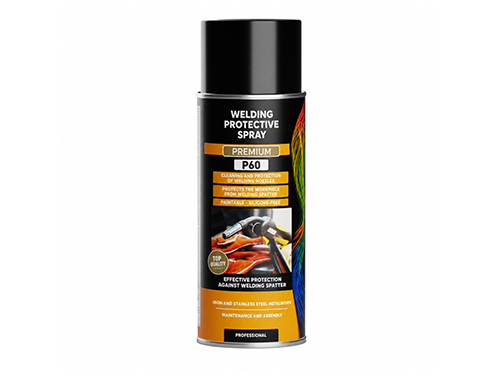
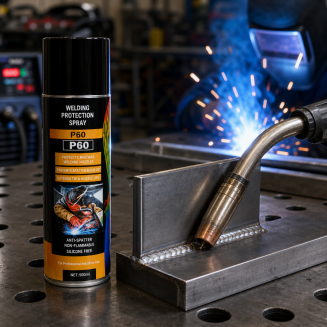
P60 Welding Protection Spray |
| Main Application |
Auxiliary reduction of welding spatter adhesion during MIG/MAG welding processes, facilitating post-weld cleaning. |
| Product Features (per current data) |
Oily solvent-based; transparent; labeled as non-flammable in documentation; described as having no distinct solvent odor. |
| Usage Reminder |
Final product claims, usage methods, and safety requirements should be based on official labels, TDS, SDS, and test results. |
1. Understanding the Product: What is P60?
P60 Welding Protection Spray is an auxiliary spray used for MIG/MAG welding operations. Its objective is to help reduce the adhesion of metal spatter on welding torch nozzles and allowable processed related surfaces, making post-weld cleaning more convenient.
Simple Understanding: High-temperature metal particles spatter during welding. P60 does not prevent all spatter from being generated; rather, it helps reduce spatter from adhering firmly to specific surfaces.
| Existing Product Description |
Layman's Explanation |
Notes for External Communication |
| Non-flammable |
Product documentation claims it to be non-flammable |
Must be backed by official SDS or test reports; does not mean it can be sprayed directly into arcs, flames, or molten pools |
| Oily solvent-based |
Belongs to an oily, solvent-system spray |
Specific solvents, VOCs, and hazard classifications are subject to formulation data and SDS |
| Transparent |
The product itself does not function primarily via distinct coloring |
Cannot promise zero residue solely based on transparency |
| No distinct solvent odor |
Current documentation description of odor |
Does not equal zero VOCs, non-toxic, or non-irritating to all individuals |
| Helps maintain welding torch |
Reducing spatter adhesion may help lighten the cleaning burden |
Unsuitable to promise extending life by a fixed number of hours or days |
2. Why is Anti-Spatter Spray Needed During Welding?
1. What is Welding Spatter?
During MIG/MAG welding, the welding wire melts to form a weld pool, during which a small amount of high-temperature metal particles may spatter into the surroundings. They can adhere around the welding torch nozzle, contact tip, workpiece surface, fixtures, and surrounding equipment.
2. What Problems Can Occur If Spatter Is Not Treated?
| Common Problems |
Potential Impacts |
| Nozzle Slag Accumulation |
Continuous spatter buildup increases cleaning difficulty; severe accumulation may affect shielding gas flow |
| Frequent Stops for Cleaning |
Operators clean frequently, increasing auxiliary operation time |
| Unclean Workpiece Surface |
Subsequent additional cleaning or grinding may be required; residues need attention prior to coating |
| Increased Maintenance Burden |
Torch-related components require inspection and cleaning, though actual maintenance cycles depend on working conditions |
The value of anti-spatter spray lies in improving these links rather than replacing correct welding parameters, torch maintenance, and necessary safety protections.
3. How Does P60 Work?
STEP 1
Spraying
Operation/Process: Spray thinly and evenly on allowed nozzles or workpiece surfaces according to instructions.
Purpose: Cover target surfaces and avoid over-spraying.
STEP 2
Forming Protective Layer
Operation/Process: Product forms a protective thin film on applicable surfaces (specific film characteristics subject to technical data).
Purpose: Help reduce the probability of firm spatter adhesion.
STEP 3
Post-Weld Cleaning
Operation/Process: Inspect nozzle and workpiece surfaces after welding; clean according to process requirements.
Purpose: Aim to lower cleaning difficulty and auxiliary operation time.
Actual effectiveness is influenced by formulation, spray volume, welding current, welding frequency, materials, and operating methods. Complete spatter prevention cannot be guaranteed solely by product name.
4. How Should P60's Main Selling Points Be Understood?
| Product Features |
Layman's Understanding |
Potential Value to Customers |
| Non-flammable (Needs verification) |
Exhibits corresponding combustion characteristics under specified test conditions |
Suitable for scenarios with specific combustion characteristic requirements; SDS and site safety rules must still be checked |
| Oily solvent-based |
Uses an oily, solvent-based system |
Can test wetting, coverage, and cleaning performance against customer's existing processes |
| Transparent |
Does not function primarily via distinct coloring |
Helps reduce the product color's impact on appearance |
| Described as low-odor |
Data claims no distinct solvent odor |
Can serve as a sampling evaluation metric; does not mean zero VOCs or non-hazardous |
| Helps reduce spatter adhesion |
Makes spatter less likely to adhere firmly to applicable surfaces |
Expected to lighten the cleaning burden |
| Easier post-weld cleaning |
Cleaning operations may become more convenient |
Expected to reduce auxiliary labor hours; actual results require testing |
Important Distinction: "Non-flammable", "No distinct odor", "VOC-free", and "Non-toxic" are different concepts and cannot replace one another. External promotions must be supported by corresponding formulation data, test results, or official safety documents.
5. Similar Market Products & Competitor Benchmarking
The following are similar products from public product documentation available for preliminary research. Differences may exist across models, regional versions, and formulations. Official quotes or competitor reports should re-verify official current data, local versions, and SDS.
| Brand / Product |
Market Positioning & Public Direction |
Recommended Comparison Items for P60 |
Official Link |
| ABICOR BINZEL Super Pistolenspray NF |
Non-flammable welding anti-spatter product; public data covers nozzle/workpiece applications and highlights silicone-free properties |
Non-flammability proof, silicone-free, residue, subsequent coating compatibility, per-can consumption |
https://www.binzel-abicor.com/DE/eng/products/accessories/welding-chemicals/super-pistolenspray-nf/ |
| CRC Weld-Aid Non-Flammable Anti-Spatter (007100) |
North American market anti-spatter product; public data emphasizes non-flammability, silicone-free, and multi-part applications |
Safety classification, spraying convenience, cleaning effect, per-unit usage cost |
https://www.crcindustries.com/weld-aid-non-flammable-anti-spatter-14-wt-oz/ |
| Dynaflux 390 Non-Toxic Anti-Spatter |
Water-based route; public data describes water-based, non-flammable, silicone-free |
Formulation type, residue, cleaning method, painting compatibility |
https://www.dynaflux.com/product/390-non-toxic-anti-spatter/ |
| ABICOR BINZEL Ceramic Spray |
Ceramic protective product emphasizing nozzle protection and long-term anti-spatter direction |
Protection duration, application steps, single-use dosage, total cost |
https://www.binzel-abicor.com/DE/eng/products/accessories/welding-chemicals/ceramic-spray/ |
Competitor Comparison Summary
| Comparison Dimension |
P60 (Per current data) |
Common Market Competitor Directions |
| Formulation Route |
Oily solvent-based |
Water-based, oily, solvent-based, ceramic-based, etc. |
| Non-flammability |
Labeled non-flammable in data, verification needed |
Some models explicitly labeled non-flammable |
| Appearance |
Transparent |
Transparent, milky white, or other appearances possible |
| Odor |
Data claims no distinct solvent odor |
Varies depending on specific formulation |
| Post-Weld Cleaning |
Goal is to facilitate cleaning |
Some products emphasize low residue or specific cleaning methods |
| Long-Term Protection |
No verifiable duration data available yet |
Certain ceramic or specialized formulations emphasize long-term protection |
| Subsequent Painting |
Residue and coating adhesion require testing |
Some products explicitly state coating compatibility |
It cannot be simply assumed that oily products are necessarily flammable or water-based products are inherently safer. Different formulations, propellants, test methods, and safety classifications vary. P60 should build its competitive edge through actual testing and comparative evaluation.
6. Instructions for Use & Precautions for P60
1. Check Equipment: Inspect nozzle for heavy spatter accumulation first; clean if necessary. Confirm the area to be treated meets product label requirements.
2. Apply Appropriately: Spray thinly and evenly on areas allowed by the label, avoiding excessive application that could cause an oil film or residue buildup.
3. Verify Waiting Time: Confirm whether waiting, drying, or wiping is required per official instructions; do not assume specific times.
4. Begin Welding and Observe: Record nozzle slag buildup, cleaning difficulty, welding status, and workpiece surface conditions.
5. Post-Weld Inspection: If painting, electroplating, bonding, or other surface treatments follow, verify beforehand that residues will not affect subsequent processes.
Safety Reminders
- Do not spray directly into arcs, flames, or molten pools just because the product is labeled "non-flammable".
- Aerosol cans should be stored, transported, and used according to label and SDS requirements with adequate ventilation.
- Confirm personal protection, site ventilation, and welding equipment requirements prior to use.
- Do not promise suitability on unverified materials or processes; perform small-scale trials first.
7. Which Customers is P60 Suitable For?
| Target Customers |
Typical Needs |
Recommended Communication Focus |
| Metal Fabrication Plants |
Frequent daily MIG/MAG welding; nozzles and workpieces require cleaning |
Reduce spatter adhesion and lighten cleaning burden; suggest on-site customer trials |
| Steel Structure Manufacturers |
Multiple welding stations, high volume of repetitive welding |
Log cleaning times per station to evaluate impact on production continuity |
| Auto Parts & Metal Component Plants |
High emphasis on surface quality and subsequent coating |
Focus on validating residue, cleaning, and coating adhesion; make no unverified guarantees |
| Welding Equipment & Consumables Distributors |
Need to expand supporting welding consumable lines |
Introduce application range, packaging specs, document compliance, and available sample support |
Recommended Product Positioning
Position P60 as: an anti-spatter auxiliary product tailored for MIG/MAG welding operations, prioritizing communication on reducing spatter adhesion, facilitating post-weld cleaning, and the non-flammable properties indicated in product documentation. Advantages in transparent appearance, odor, and cost should be highlighted as primary selling points only after test or trial results are available.
 English
 Français
 Tiếng Việt