English
 Français
 Tiếng Việt
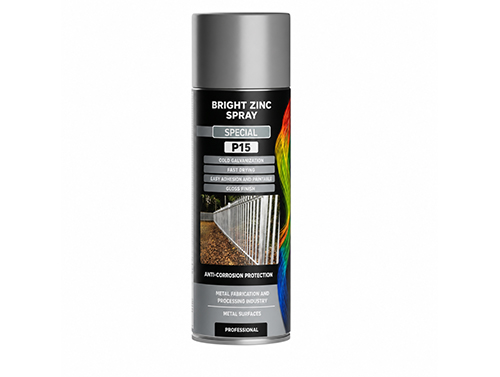


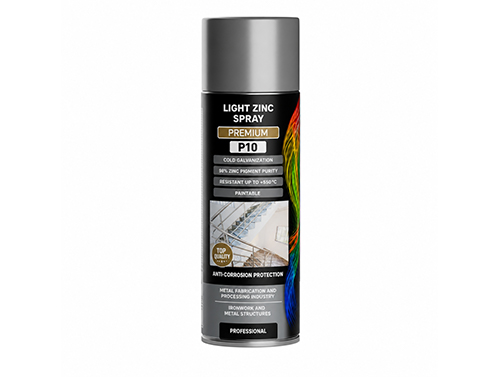
P10 Premium is an aerosol coating product designed for metal surface anti-rust protection and galvanized appearance repair. After spraying, it forms a light gray metal-texture protective film, suitable for small-area repairs, post-welding treatment, metal component maintenance, and other scenarios. According to existing product documentation, key selling points include fast drying, good adhesion, salt spray testing exceeding 250 hours, and a nominal heat resistance temperature of +550°C. The above performance must be subject to the final version TDS, test reports, and explicit test conditions.
| Item | Information in Current Data | To Be Confirmed Before Sales |
| Product Name | P10 Premium Zinc Spray / Advanced Zinc Spray | “Transparent Zinc Spray” may contradict the light gray galvanized appearance; it is recommended to confirm whether to change it to Zinc Spray or Zinc-Aluminium Spray. |
| Product Mechanism / Formula Description | Contains 98% pure zinc and aluminum pigments (original description) | Is 98% raw material purity, formula content, wet film content, or dry film metal content? Do not write “98% zinc in dry film” before confirmation. |
| Appearance | Light gray after drying, close to the color of galvanized parts | Confirm color code, gloss level, and whether there are different color versions. |
| Anti-Corrosion Performance | Salt spray test exceeds 250 hours | Supplement test standards, film thickness, substrate, pretreatment, scribing method, acceptance criteria, and report. |
| Heat Resistance Performance | Nominally high temperature resistant up to +550°C | Confirm whether it is a short-term peak or continuous operating temperature; confirm color change, adhesion, and anti-corrosion performance after high temperature. |
| Drying / Recoating | Fast drying; can be recoated after drying | Confirm surface drying, thorough drying, recoating interval, and compatible topcoat types. |
| Packaging and Trade | Aerosol can product | Confirm net content, can size, pieces per box, shelf life, hazardous goods transportation classification, and destination port requirements. |
When steel encounters environmental factors such as moisture, oxygen, and salt, it gradually corrodes, forming reddish-brown rust. Salt spray, coastal air, road deicing salt, and industrial humid environments all accelerate corrosion. The purpose of an anti-rust coating is to reduce the chance of metal contacting corrosive environments, or to provide extra protection through a more reactive metal.
Zinc undergoes electrochemical oxidation more easily than iron. In a suitable zinc-rich coating system, when zinc particles form effective electrical contact with steel, the zinc can be consumed preferentially, thereby providing “sacrificial anode/cathode protection” to the steel. In layman's terms: zinc “sacrifices itself” first to help protect the steel underneath. The coating itself can also form a physical barrier. The actual protection effect depends on the zinc content caliber, particle connectivity, paint film thickness, surface treatment, environment, and construction quality.
Hot-dip galvanizing is a factory process that forms a zinc layer on the surface of steel parts; aerosol-type zinc spray forms a coating via on-site spraying, commonly used for local repairs, weld seams, cut edges, and parts difficult to return to the factory as a whole. You cannot promise the exact same service life as hot-dip galvanizing solely based on the name “zinc spray,” nor can you claim it can completely replace hot-dip galvanizing without validation.
| Type | Main Function | Typical Use Scenario | Points to Note |
| Zinc-Rich Spray / Cold Galvanizing Spray | Appearance repair + barrier protection; suitable systems can provide sacrificial zinc protection | Galvanized parts repair, post-welding/cutting local treatment, metal maintenance | Must confirm dry film zinc content, test standards, and application requirements. |
| Regular Silver/Aluminum Paint | Provides color and surface coverage mainly | Decoration, appearance renovation | Silver-gray appearance does not imply zinc-rich electrochemical protection. |
| Regular Anti-Rust Primer | Relies mainly on barriers, corrosion-inhibiting pigments, or resin systems for protection | Large-area coating, matching coating systems | Must choose based on substrate, environment, and topcoat matching. |
| Hot-Dip Galvanizing | Factory process forming a zinc layer | New steel structural components, batch metal parts | Requires specialized equipment and processes; on-site local repair is less convenient than spray. |
Aerosol cans are suitable for on-site construction and local repairs, especially for exposed metal surface areas generated during welding, cutting, handling, or installation. Do not exaggerate it as “permanent anti-rust in any environment.”
The light gray color after drying resembles galvanized parts, which facilitates color coordination after repair. It is recommended to provide before-and-after spraying comparison images, noting that actual color may vary slightly due to substrate, spraying thickness, and lighting.
Aerosol spraying is suitable for small areas, edges, and complex shapes; construction speed is usually more convenient than brush-applied local repairs. Specific surface drying time should rely on real TDS values.
Can serve as a reference indicator for laboratory corrosion resistance performance, but cannot be directly equated to years of outdoor service life. Salt spray results must be interpreted together with test standards, film thickness, and acceptance criteria.
This is a differentiator customers may care about, but it must be confirmed whether it is continuous or short-term heat resistance, and whether color, adhesion, and anti-corrosion capacity remain compliant after high temperature. Not recommended to advertise as “can work long-term in a 550°C environment” before confirmation.
| Scenario / Customer | Customer's Real Pain Point | Recommended Communication Angle |
| Metal Processing Plants, Welding Workshops | Local exposure after welding or cutting, fear of rust | Local repair, ease of operation, color close to galvanized parts. |
| Steel Structure Installation / Maintenance Contractors | Scratches, corners, and small area damages on site | On-site maintenance, reducing disassembly and factory return processing. |
| Fence, Bracket, and Railing Manufacturers | Small-area repair needs on finished products | Quick repair and uniform appearance; test adhesion and color first. |
| Automotive Repair / Equipment Maintenance Stores | Metal components need maintenance or appearance renovation | Emphasize applicable substrates and temperature limits; do not imply suitability for all automotive parts. |
| Hardware, Spray Importers / Wholesalers | Need differentiated industrial maintenance spray products | Provide product portfolio, TDS/SDS, packaging diagrams, box dimensions, MOQ, and export shipping data. |
| Industrial Consumables Distributors | Customers need commonly used maintenance aerosol products | Cut in with maintenance convenience, application scope, and reorder opportunities. |